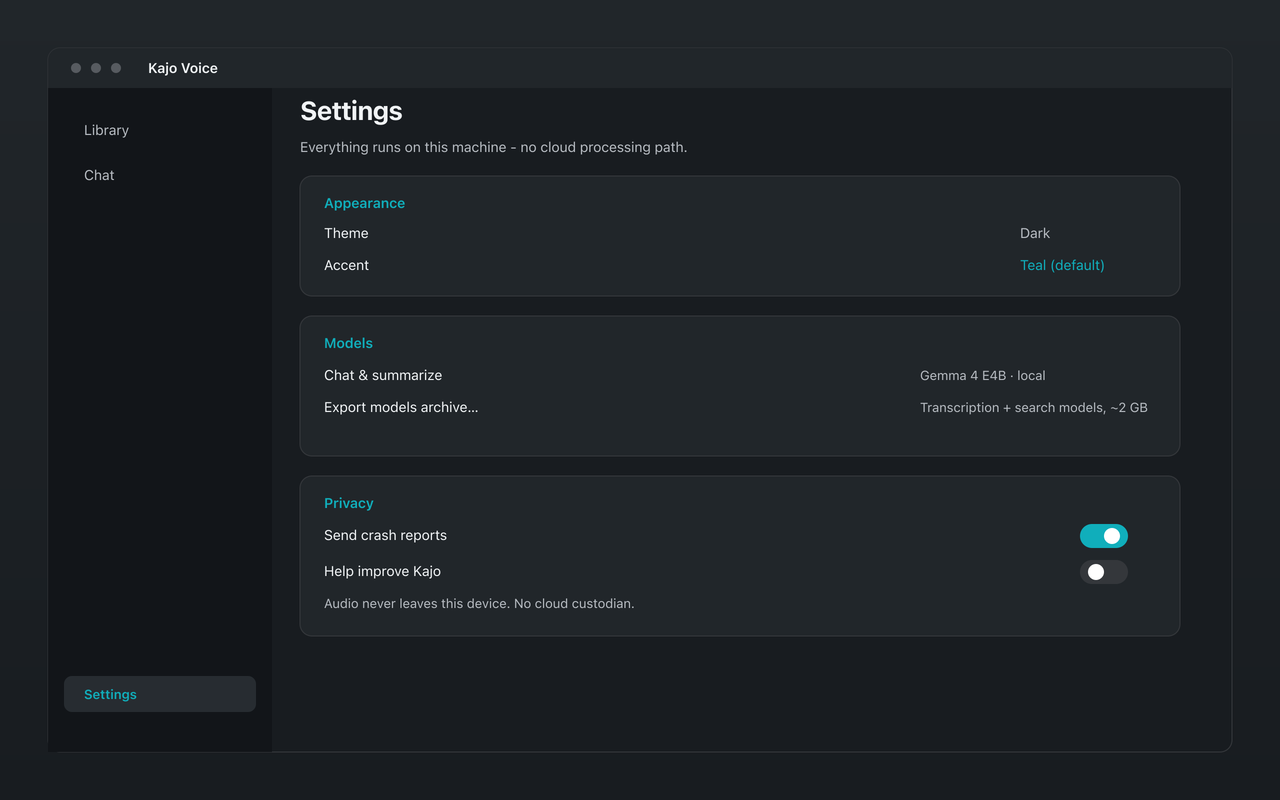
Why on-device matters in a therapy practice
A therapy session is among the most sensitive recordings a person will ever be part of. Most AI transcription services work by uploading that audio to a cloud server, running it through a hosted model, and keeping the result on infrastructure you do not control — which creates a copy of a confidential session under someone else’s retention policy.
Kajo removes the upload. Transcription runs on the computer in your office, and summaries and chat run on the same local model. There is no “process in the cloud” setting to forget, because there is no cloud-processing path in the product at all.
Kajo vs a cloud AI transcription service
| Consideration | Kajo | Typical cloud service |
|---|---|---|
| Session audio sent to a server | Never — processed on your computer | Yes |
| Third-party copy of the session | None | Kept by the vendor, under its retention policy |
| Works with the network off | Yes | No |
| Who can delete it | You, in the app | You, in the vendor’s app; its servers and backups follow its policy |
| Price | $49 launch / $99 standard, one-time | Usually a monthly subscription |
Consent, and the room
Recording a session — even just for your own review — changes the room, so it should always be an explicit, documented conversation with the client, never a default. Kajo makes that conversation easier to have honestly: you can tell a client, truthfully, that the recording never leaves the computer in your office, that no company is listening to or training on their words, and that you can delete the session and its transcript whenever they ask.