Offline AI transcription — running a speech-to-text model entirely on your own device without any internet connection — was largely theoretical before 2022. The models that existed were either too small to be accurate or too large to run on consumer hardware in reasonable time.
Open-weight speech models changed this. Kajo Voice runs one of them on-device — Transcribes 99 languages on your laptop — all on-device. What the model is and why it fits on a laptop: the engine guide. This guide is about the other half of the promise: download once, then run the whole loop with the network off.
What downloads, and how big it is
Setup downloads ≈7 GB of models once, before first use; everything runs offline afterwards. Every model comes from Kajo’s asset CDN, with Hugging Face as a fallback, and is checked against its pinned checksum before it is used. If LM Studio, Ollama, or the Hugging Face cache on your computer already holds a byte-identical copy of a model, Kajo uses that copy instead of downloading it again. That download is the one step of setup that needs a connection.
What works with the network off
Everything in the loop:
- Transcription, with automatic speaker labels
- Translation into 59 languages
- Summaries — pin a recording and run the Summarize starter, with the chat’s reminder to review before anything leaves your machine
- Cited chat across a folder or, with a confirm, the whole library
- Every export: SRT, VTT, TXT, CSV, JSON, Markdown, DOCX, PDF, QDPX
Turn the network off, drop in a file, and nothing changes. The same models run whether or not you are connected, so offline does not change the transcript.
What still talks to the network — the honest list
- The model download. Once, during setup.
- Licence activation and checks. Activating Lifetime needs the network once. After that the app verifies your licence on your own machine and keeps it working offline, with no expiry; when it is online, it checks once a day that the licence has not been revoked. The requests carry your licence key plus an install or session id — never content.
- Update checks. On by default; switch them off in Settings → General (“Check for updates automatically”, or on Windows, where the Microsoft Store installs updates, “Tell me when an update is available”). They ask whether a new version exists and send nothing of yours.
- Crash reports. Only if you agree when the app asks at first run; change it any time with “Send crash reports” in Settings → Privacy. They go to Sentry — stack traces and device metadata, never audio or transcript text.
- Product analytics. Off unless you tick “Help improve Kajo”, at first run or later in Settings → Privacy. Then the app sends usage events — which features you use, how long they take, error details — to PostHog in the EU, with a random ID created when you opt in; never audio, transcripts, file names, or chat text.
- Feedback. Only when you choose to send it from the app.
Never: audio, transcripts, summaries, or chat. There is no cloud-processing path to enable.
How to verify it yourself
Put the machine in airplane mode, or watch it with a network monitor, and transcribe a file. No audio and no transcript leave. The traffic you will see from Kajo is the licence check and update checks — plus crash reports and usage events, if you agreed to send them. None of it carries your audio or text.
The hardware floor
- RAM: 16 GB minimum. Kajo itself uses about 6 GB with the chat model loaded and about 8 GB with everything running; the rest is headroom, so the machine stays usable while a batch works.
- Apple Silicon: the speech model and speaker labelling both run with Metal GPU acceleration.
- Windows, Linux: the speech model and speaker labelling run on the CPU (a Windows ARM PC runs the whole app as its x64 build, under Windows 11’s emulation; Linux has native ARM64 builds). Slower — queue a batch and let it work. On x64, the chat model can use a GPU through its own runtime.
Our own speed measurements, and the one machine they were taken on, are on What runs on your machine. Windows and Linux have not yet been timed on their own hardware, so time one real file on the free allowance.
Why offline matters: the practical scenarios
Airplane mode. Transcribe your interview recordings on a flight before the conference where you’ll need them. Many professionals do their review work during travel.
Client-site laptops. Many firms and secure facilities have restrictive network access — guest networks are segregated, managed workstations have limited internet access. Local transcription works on the workstation without any network dependency.
Field research and remote reporting. Researchers doing fieldwork and journalists on a burner laptop often work with poor or no connectivity. Local transcription works on spotty Wi-Fi or with no connection at all.
Policy. Some organizations prohibit sending audio to external services. Local transcription complies by design.
Building an offline knowledge base from your recordings
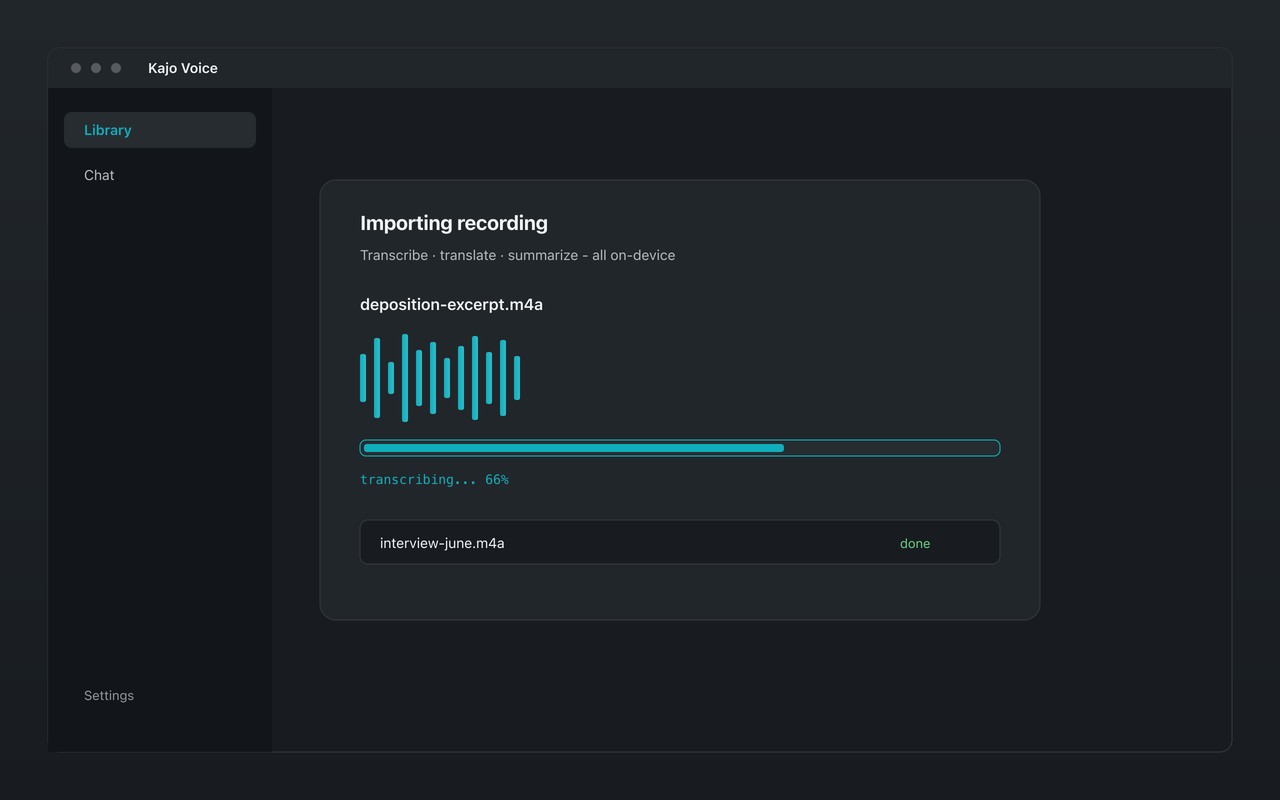
Offline transcription is the first step, not the whole workflow. Every file you drop into Kajo — an interview, a deposition, a session recording you already have — is transcribed on-device with speaker labels and filed into a private, searchable library, where Kajo translates and summarizes it locally whenever you ask. Because all of this happens on your machine, the entire knowledge base works in airplane mode or with the network unplugged.
Once a recording is in the library you can pin its folder and ask it, with citations back to the source audio — no network required.
Offline options compared
Raw whisper.cpp or faster-whisper give you the same underlying model for free, but they are command-line tools — no interface, no automatic speaker labels, no library, no cited chat. Mac apps such as MacWhisper and Aiko put a friendly interface on it, on the Mac. Kajo Voice is the desktop path on Mac, Windows, and Linux: on-device transcription with speaker labels, exports, folders, and a private library you can ask with citations — still fully offline after the one-time model download.
FAQ
Do I need internet to transcribe a file in Kajo? No. After the one-time model download, you drop in an audio or video file you already have and Kajo transcribes it locally. No internet is required during transcription, translation, summarization, or chatting with your library.
How much storage does offline transcription require? About 7 GB for all the models, plus the app. Transcripts and the app’s audio copies stay on your disk until you delete them.
Does offline mode affect transcription quality? No. The same model runs whether or not you have a network connection.